


Stress Management to Mental Engineering

As a small business owner, you’re likely used to wearing every hat in the company. On any given Tuesday, you might be the CEO, the HR manager, and the person fixing the jammed printer. This constant “switching” creates a specific kind of mental fog that traditional advice—like “just take a deep breath”—doesn’t always fix.
Recent research suggests that we’ve been looking at mindfulness all wrong. Instead of using it as a “Band-Aid” for stress, we can use it as Cognitive Engineering—a way to actually design how we react to the chaos of running a business.
The Two Modes of a High-Performance Mind
To stay productive without burning out, the latest framework suggests you need two different “gears” in your mental engine:
1. Stillness Engineering (The Foundation)
Think of this as your “Mental Reset Button.” In the research, this is called Classical Mindfulness. Its job is to create a stable container for your thoughts so you don’t get swept away by them.
- The Goal: To observe your stress without becoming it.
- The Small Biz Application: When a client cancels a contract, “Stillness Engineering” allows you to notice your racing heart and defensive thoughts without letting them dictate your next email. You become the observer, not the victim of the moment.
2. Structural Navigation (The Navigator)
This is where it gets interesting. Once you are calm, you move into Quantum Mindfulness. Instead of just watching your thoughts, you start to navigate them like a map.
- The Goal: To actively shape your experience and see multiple solutions at once.
- The Small Biz Application: Instead of seeing “Burnout” as one big, heavy blob, you break it down into dimensions: Is it a lack of purpose? Is it poor energy management? Is it a need for total control?. By diagnosing the structure of the problem, you can fix the specific part that’s broken.
Moving from “Witnessing” to “Mastery”
Most productivity hacks tell you to “manage” your time. This framework tells you to engineer your presence.
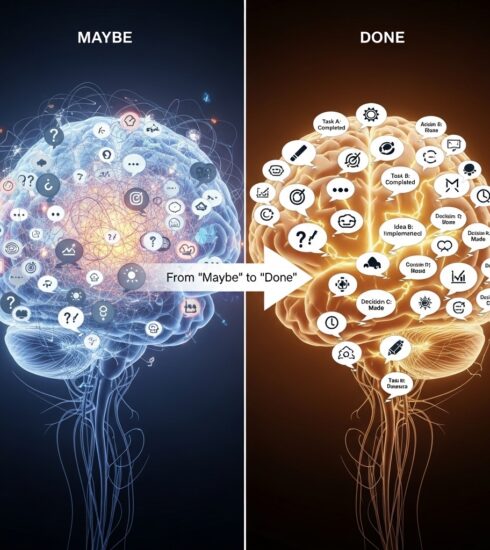
When you face a high-stakes decision, don’t just react. Practice Vectorized Awareness—which is a fancy way of saying “intentional focus”. By holding multiple “strategic futures” in your mind at once (a state called Superposition), you avoid rushing into a binary “yes or no” choice too early. This allows the best solution to “collapse” into reality based on data and intuition, rather than panic.
Your 3-Step Action Plan
- Stop the Hijack: Use “Stillness Engineering” (breathing and anchoring) the moment you feel a physiological stress response.
- Map the Problem: Don’t just say “I’m stressed.” Ask yourself which “dimension” is off—is it your energy, your identity, or your need for control?.
- Hold the Tension: Before making a big pivot, sit with the different possibilities. Don’t rush to “fix” the feeling; let the best strategy emerge from a place of clarity.
By mastering both the stillness of the observer and the agency of the participant, you aren’t just surviving the work week—you’re engineering a more resilient business.
Reference Information
- Author: F. Dion, Ph.D.
- Title: Optimizing Cognitive Architecture: An Integrated Framework of Classical and Quantum Mindfulness for Professional Development
- Publisher: TUOS Press (2023)
- DOI: 10.5281/zenodo.18398370
- ORCID: 0009-0008-2558-4897